Monday, December 12, 2022
Paths: Ontario and NCAA hockey
Ontario’s impact is as vast and wide as the province itself
This article was originally published December 12, 2022. It was most recently updated on November 14, 2025.
By Sean Hogan, Chris Meriney and Jayson Hajdu
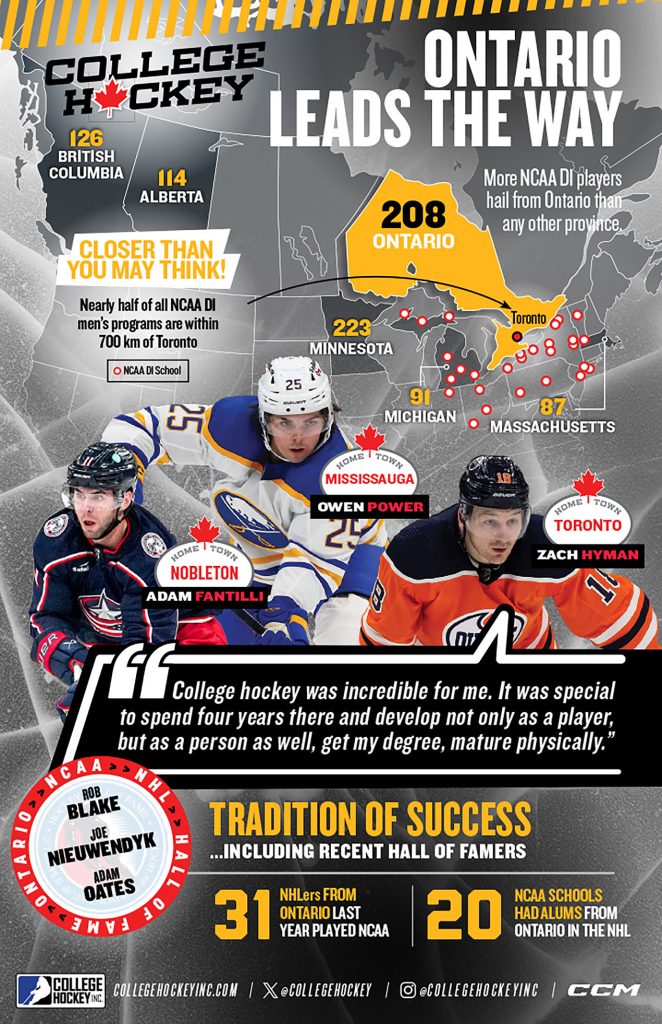
Ontario has long been a fruitful recruiting ground for NCAA Division I men’s hockey. In 2025-26 alone, more collegiate players hail from Ontario (208) than any other province, up from 184 in 2024-25. The new rule change allowing players who compete in the CHL to retain their NCAA eligibility will likely see that trend continue.
That’s hardly surprising given its status as Canada’s most populous province, but Ontario isn’t just churning out quantity; it is also well-established for producing high-end NCAA hockey players.
Three of the NCAA’s top 10 scorers at the time of this writing – Michigan teammates Michael Hage (Mississauga) and T.J. Hughes (Hamilton), and Bemidji State’s Oliver Peer (Burlington) – come from Ontario, as do returning all-conference performers such as Merrimack’s Trevor Hoskin (Belleville), North Dakota’s Ellis Rickwood (Brantford), and UMass’ Matthew Wilde (Mississauga)
The enormous impact Ontario natives are having on college hockey is nothing new. Hockey Hall of Famers Ken Dryden (Hamilton), Rob Blake (Simcoe), Tony Esposito (Sault Ste. Marie), Joe Nieuwendyk (Oshawa) and Adam Oates (Weston) all starred collegiately. Fellow Ontarians Tony Hrkac (Thunder Bay) and George McPhee (Guelph) won the Hobey Baker Memorial Award on their way to the National Hockey League.
How Does It Happen?
Is there a common path for Ontarians to best optimize NCAA opportunities? College Hockey Inc. studied the paths of the 208 players from Ontario who are on NCAA Division I men’s hockey rosters in 2025-26.
Noteworthy themes that emerged from the Ontario study:
- Ontarians play in a wide array of leagues at age 17, emphasizing the varied paths to the NCAA.
- Only 15 percent (32 of 208) of the NCAA commitments were earned by minor hockey players.
- The average age of a player from Ontario earning an NCAA commitment was 19.7.
- 85 percent of players earned their commitment while playing junior hockey.
Of the 208 Ontario NCAA DI players, 69 players played in the CHL and 16 players transferred from USports to the NCAA.
The Data: Hockey Before NCAA
The average commitment age of players from Ontario was almost 20-years old. A vast majority of those players – 85 percent of them, to be precise – earned their commitments while playing junior hockey.
As evidenced by the numbers below, Ontarians can be playing in a variety of leagues and locales and still have an opportunity to reach NCAA Division I. Of note, approximately 25 percent were not yet playing junior hockey at age 17.
| Where Ontarians played when they earned their commitments: | |
| League | No. |
| OHL | 43 |
| BCHL | 37 |
| OJHL | 34 |
| NAHL | 17 |
| USports | 16 |
| USHL | 14 |
| AJHL | 10 |
| CCHL | 9 |
| CDN HS | 7 |
| QMJHL | 5 |
| U16 AAA | 4 |
| MJHL | 3 |
| Prep | 3 |
| NCDC | 2 |
| AHL | 1 |
| SJHL | 1 |
| GOJHL | 1 |
| U18 AAA | 1 |
| Where Ontario NCAA commitments were playing at 17: | |
| League | No. |
| OHL | 51 |
| OJHL | 48 |
| U18 AAA | 21 |
| GOHL | 20 |
| CCHL | 15 |
| CAHS | 14 |
| Prep | 13 |
| USHL | 10 |
| NOJHL | 4 |
| AJHL | 3 |
| No info | 3 |
| NCDC | 2 |
| NCAA | 1 |
| USHS-MN | 1 |
Case Study I: Trevor Hoskin
Merrimack sophomore forward Trevor Hoskin, a native of Belleville, followed a linear path to college hockey, playing two seasons (2018-20) of AAA hockey in the Ontario Minor Hockey Association’s then-ETAHL, followed by three standout seasons with the OJHL’s Cobourg Cougars.
In between his final year at Cobourg and his freshman NCAA season at Niagara, Hoskin was selected by the Calgary Flames in the fourth round of the 2024 NHL Draft.
Hoskin’s Ontario hockey development was on full display during his first NCAA season in 2024-25. He racked up 39 points in 36 games and was named Atlantic Hockey America (AHA) Rookie of the Year.
“You know, you’re a late bloomer and everybody is thinking about the top-touted younger players,” Hoskin told the Calgary Herald in March 2025. “But in my eyes, I think it’s never too late, and I think I’ve proven that with how late I was drafted. You can develop and you can hit the wind at any age, and you can get there, right?”
Hoskin added: “There are tons of stories like that, so I think that’s something you have to believe in if you want to do it.”
Hoskin is playing at Merrimack for his second NCAA season, where he leads the Warriors in points (14) and assists (10) through the first 14 games of the season.
In that same Calgary Herald article, Hoskin said that patience was key on his developmental path.
“Sometimes, people want it to go too quick,” he said, “and they wonder why they’re not there yet.”
Case Study II: Adam Fantilli
Although not a typical or necessary path for NCAA-bound players from Ontario, Adam Fantilli played his U16 year at Kimball Union Academy, a historic prep school in the United States. U.S.-based prep schools have long played a vital role in the path to NCAA hockey for aspiring players in the northeastern United States (however, the schools are open to hockey players from everywhere).
Family considerations factored heavily into the decision for Fantilli, who was able to play with his older brother, Luca, at Kimball Union.
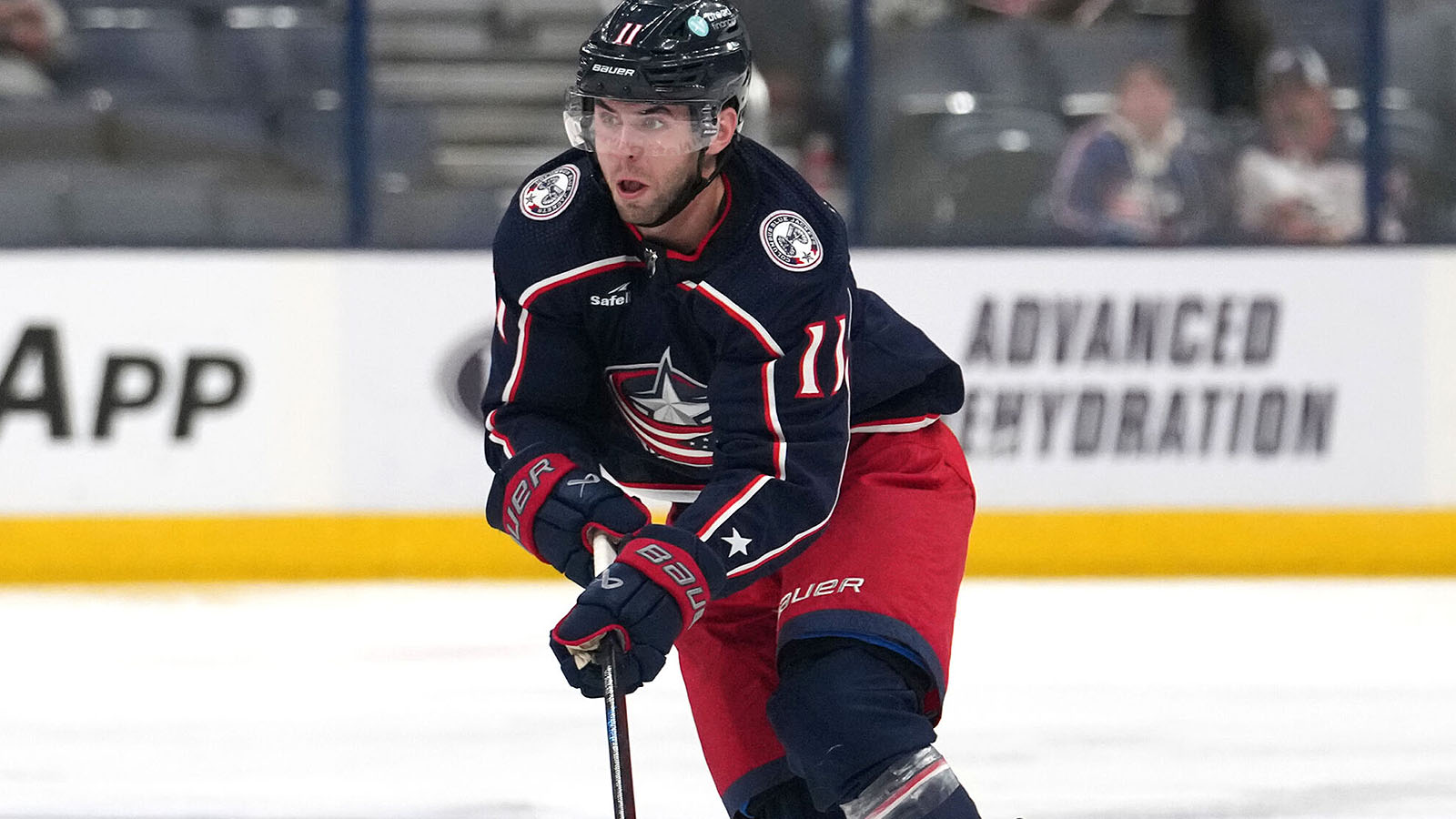
Following his time at Kimball Union, the Nobleton native played two seasons in the USHL – again reuniting with his brother – where he won a Clark Cup title as a rookie and captured All-USHL First Team honors his second year.
Fantilli then made a massive, immediate impact as a freshman at the University of Michigan, winning the 2022-23 Hobey Baker Award as the best player in NCAA Division I men’s hockey.
“I think once I got older and matured a little bit, I saw the benefits to going to college. I thought that was the right route for me,” Fantilli told The Michigan Daily.
Following a freshman season that also saw him lead the Wolverines to the NCAA Frozen Four, Fantilli was drafted third overall by Columbus at the 2023 NHL Entry Draft. He is currently in his third NHL season with the Blue Jackets.
There has been a common conclusion throughout College Hockey Inc.’s previous “paths” studies: that a player does not need to leave home to be on the radar of NCAA Division I recruiters but rather, playing and playing well are most important.
This certainly holds true for the province of Ontario, as evidenced by the sheer number of Ontarians committing to and playing for NCAA Division I schools. Leagues within the province, such as the OHL and other junior hockey leagues, play a vital role in player development for future NCAA Division I players.
For young aspiring hockey players in Ontario, the optimal path to NCAA Division I hockey is the one that begins right in their own backyards.
NOTE: Click HERE to view each of College Hockey Inc’s “paths” studies.